

Supplementary Material – Bryophytes
Borges et al. (2018)
BRYOPHYTES
PROTOCOL 1
BRYOLAT methodology (Ah-Peng et al. 2012) (and see our Fig.1, main text and Fig. S1 below)
Taxa - Bryophytes; ferns
Experimental design – two 10 m x 10 m plots within the main 50 m × 50 m plots (Fig. S1)
Download PDF
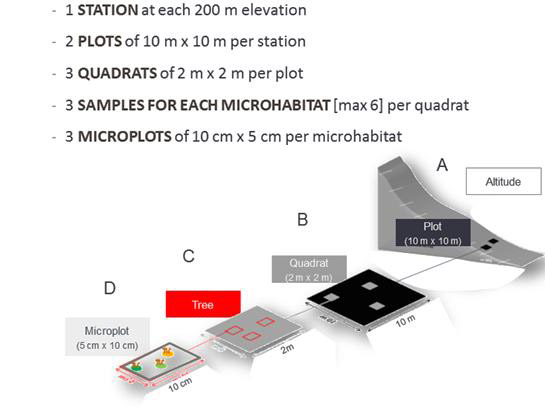
Figure S1. BRYOLAT Protocol:
a) A transect on an given island; at 200 m elevation steps, two plots (black squares, 10 m × 10 m) are placed within 10 to 15 m of each other;
b) each plot is divided into 25 quadrats (grey squares, 2 m × 2 m), from which three are sampled; c and d – each quadrat is thoroughly examined for different substrata, and three microplots (red rectangular shapes, 5 cm × 10 cm) are collected on every microhabitat, except on trees, where nine replicates are made.
Frequency - The complete protocol should be applied for an initial inventory. The monitoring protocol as described in the main text is adequate for sampling every ten years.
Protocol 1A - The complete inventory Protocol (24 samples per 2 m × 2 m quadrat)
Corticolous (TA, TB, TC): selected on three trees at 3 different heights (TA: 0-50 cm, TB: 0,5–1 m and TC: 1–2 m), when populations are present. For each elevational level, a total of 54 collections of 50 cm2 each can be achieved if no restrictions on the presence of microhabitats and/or bryophytes are encountered.
Epiphyllous (Lf): in each quadrat, three samples of epiphyllous bryophytes are collected, depending on the size of the vascular plant’s leaf. Try to get a surface of 5 cm × 10 cm. Sometimes, for tiny leaves it is necessary to collect many of them, whereas for large plants, it will be necessary to select and cut a surface of 50 cm2.
Humicolous (Hu): three samples per quadrat are taken from the humus on the ground; this corresponds mainly to the carpet mosses (at high elevations).
Lignicolous (Li): three samples (50 cm2), per quadrat, are selected on decaying wood when the habitat is available. Samples are collected at the surface of the decaying wood.
Rupicolous (Ru): three samples (50 cm2), per quadrat, are selected on rocks when the habitat is present.
Terricolous (Te): three samples (50 cm2), per quadrat, are selected directly on the soil. It is important to try to collect samples that look different on the ground to capture most of the diversity.
SAMPLING EFFORT: It is advisable to have two researchers per 2 m × 2 m quadrat, in which one is preparing the sample envelopes and labelling them while the other is doing the sampling and characterizing the habitat, allowing to double check sample labelling as well as bryophyte presence for each microhabitat. Two persons take 15–20 min per quadrat; thus for each elevation level, protocol execution takes 40–45 min with a team
of six people. All specimens from one quadrat will be transferred to a plastic bag labelled with the elevation and quadrat number.
LAB WORK: After the fieldwork, samples are air-dehydrated by leaving them open, in the sun for 1–2 days or in a well-ventilated room, and then curated. Envelopes are folded from A4 paper, reporting how many samples have been collected for each microhabitat and at each elevation. Subsequently, all bryophyte species are sorted out at the genus level and listed on the back of the envelope. The coefficient of Braun Blanquet is applied for phytosociological purposes. After sorting out the specimens at the genus level, the determination at species level for all specimens is done by genus for each group separately (mosses, liverworts and hornworts). This accelerates the process of identification, as in rain forest a surface of 50 cm2 can host more than 20 species, so working on one genus at a time facilitates the identification by using homogeneous literature.
Protocol 1B - The optimized monitoring Protocol (9 samples per 2 m × 2 m plot)
Corticolous (TA): selected on three trees at TA (0–50 cm). For each elevational level, a total of 18 collections (3 samples × 6 plots) of 50 cm2 each can be achieved if no restrictions on the presence of microhabitats and/or bryophytes are encountered.
Corticolous (TC): selected on two trees at TC (1-2 m). For each elevational level, a total of 18 collections (3 samples × 6 plots) of 50 cm2 each can be achieved if no restrictions on the presence of microhabitats and/or bryophytes are encountered.
Humicolous (Hu): two samples per quadrat are taken from the humus on the ground; this corresponds mainly to the carpet mosses (at high elevation).
Rupicolous (Ru): one samples (50 cm2), per quadrat, is selected on rocks when the habitat is present.
Terricolous (Te): one samples (50 cm2), per quadrat, is selected directly on the soil. It is important to try to collect samples that look different on the ground to capture most of the diversity.
SAMPLING EFFORT: This will imply a third of the effort of the original inventory protocol.
References
Ah-Peng C, Wilding N, Kluge J, Descamps-Julien B, Bardat J, Chuah-Petiot M, Strasberg D et al. (2012) Bryophyte diversity and range size distribution along two altitudinal gradients: Continent vs. Island. Acta Oecol-Int J Ecol 42:58-65. doi:10.1016/j.actao.2012.04.010